In a few days 2015 will be drawing to a close. In many ways it was a wonderful year but part of me is glad that it is almost over. Don’t get me wrong, there have been some tremendously special moments even if it was quite the roller coaster ride.
The year started out positively enough with my cardiologist lifting all restrictions and I began to kick things up a few notches at the gym. It was much fun and without the restrictions I was able to work on lifting more weight. I was getting stronger. I would often go with my friend Carla and then we’d go out for tea or on a shopping excursion.
I started to knit more especially seeing that one of my very best friends was expecting. I swore at the beginning of 2015 that I would not end up with a yarn stash bigger than a single Rubbermaid container. My knitting and crocheting friends laughed but I insisted I wasn’t going to stash yarn. Well, I’m close to starting my third container. Oops. We won’t talk about the KnitPicks needle purchases. I managed to finish quite a few practical items including a blanket and hat for my friend’s baby, several winter hats for my daughter, baby washcloths, dishcloths, and a few cowls. I still have a poncho, a left yoga sock, a baby sweater, and another baby blanket to finish. Knitting really helped me get through some of the more difficult moments of the year.
I re-evaluated many relationships and made great change there. There were a few toxic people in my circle that I needed to distance myself from. This has been a recurring theme in my life as I tend to be overly accepting and kind even in instances where I probably shouldn’t be. I also tend to be too forgiving. My life has been much less stressful without the drama. While they may have been lovely people, sometimes that just isn’t enough. When someone is not respectful or honest with me then I am forced to make difficult choices and that meant that I had to put myself first by distancing myself from those who are not mutually supportive. These changes made room to grow relationships with other people where there is a balance between give and take.
I booked quite a few races for 2015 including a half marathon but unfortunately only managed to run at one event. It was painful for me to have to drop out of event after event and let my friends down. I did manage to run and walk at the Long Point Eco-Adventures’ Smugglers Run Trail Race in July. In hindsight, that might not have been such a good idea but at the time I was oblivious to the fact that my body had created scar tissue inside my stent and into my left circumflex artery. Still, the run was fun and memorable.
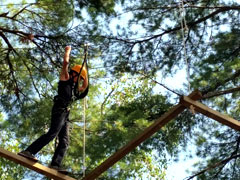
aerial obstacle course
We took our children to Santa’s Village in Bracebridge, Ontario for four or five days and they had a blast. So did Bryan and I. The guys completed the aerial obstacle course and did the whole ziplining thing at Sportsland. My little girl did her first flips on the trampolines there too. Santa’s Village is included in the camping package and is quite a lot of fun. The Sportsland side isn’t and it can get expensive, however, the adventures great albeit geared to the older kids and kids at heart. Santa came to our campsite a few times and the Elves even dropped off a gift in the middle of the night—it was like Christmas in July. My five-year old daughter was delighted and full of wonder. I think she may have even overfed Dasher. When we weren’t across the street at Santa’s Village, we were in the swimming pool cooling off.
One of the highlights of that trip, for me, was being able to perform a random act of kindness. As we were packing up to leave I took a half bag of wood to a family at a neighbouring campsite. This is something we always do when we are camping. This time around we had some extra Sportsland tickets to pass on as well. A grandmother was sitting at the picnic table while her grandchildren were at the nearby playground with my children. A tear streamed down her cheek as she thanked me over and over again. Then she struggled to her feet and gave me the warmest embrace. Sometimes we receive the best gifts in giving to someone else. You see, Grandma had mobility challenges and a limited income but took every cent she had to do this trip for her grandkids. She was their only guardian and wanted them to have some wonderful summer memories. She went on to mention that, after she paid for the camping package, she’d had only enough money to buy wood for the first night’s campfire and they wouldn’t be able to have a fire all weekend. It was Thursday and now they would have wood for a second night which she would save until Saturday. She was so grateful because she would get her pension on Monday and only then would she be able to buy more wood. I wished her well, told her I was glad that the wood would go to good use, and said goodbye. I spoke with Bryan and we agreed that my son and I would walk up to the office and pay for wood, as well as kindling, to be delivered to her campsite each day anonymously. The owner of the campground, Sarah, was so moved by what we were doing that she covered the cost of half the wood so that the family wouldn’t have to worry about a campfire for the rest of their stay.
A few weeks later, I learned how to shoot a handgun. Our family belongs to a local shooting range where Bryan and Tobias like to target practice with the bows and firearms. Bryan thought it would be a lovely to have a date night at the range. Firearms aren’t really my thing at all but I support his hobbies just like he supports mine. The handgun we were using was a Smith & Wesson M&P 9mm. Bryan was positive that he was going to show me how it was done so he suggested a little friendly competition. I’m pretty sure that he figured it was beginner’s luck at first. By the time the third target sheet was finished he was ready to admit defeat. I’m a pretty good shot. It makes me smile to think that after two decades of marriage I can still get him to look at me with a twinkle of surprise. My arm was pretty sore from the recoil but it was much more fun than I expected.
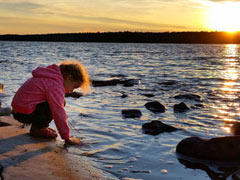
sunset at Cyprus Lake
Then it was off to Bruce Peninsula National Park, the Grotto and Cyprus Lake. We opted not to go canoeing again this year. While we adore paddling there are other things we want to do as well. Looking back, it was likely a good thing we weren’t in the wilderness this summer. I didn’t feel well on this trip but I thought maybe some of that was because my arm was sore from the adventure at the range and too many late nights. Later I found out it was because of scar tissue in the arteries of my heart which lead to the mild heart attack two days after coming home. Had I come home when this first reared its ugly head, I could have possibly have avoided some of the issues. It is what it is and there is no sense dwelling on how things may have been different. I wouldn’t trade hiking to Indian Head Cove with my son for the world but I should have listened more carefully to my body. Lesson learned.
September came, school started and I had the all-clear to start running again. Bryan headed off to Germany at the beginning of October and I ended up in the hospital again. This time there was an issue in another part of my heart and I had to fight to get the care I needed. A third hospital visit was necessary at the end of October. Thankfully that one turned out to be a mere reaction to a new medication that was prescribed by the hospital a few weeks before. At the beginning of December I was given the all-clear to start running and going to the gym again.
This year, for me, was not just about physical survival, it was about surviving emotionally too. The loss of my Mom in 2013 returned with another tremendous tidal wave of grief and the heart issues also hit me really hard mentally. This wave of sadness wasn’t just because of missing her and the realisation that I came a little too close to having my own children grieve for me—this summer our friend Chuck passed away. I couldn’t attend his memorial because of my own health so I will be running in his memory for the 10K Run at the Ride for Heart as my way of honouring him. Chuck’s passing is one of the reasons I chose to accept the role of Run Ambassador for the Heart & Stroke Foundation. I am still here and that is a great gift not to be taken for granted.
The rest of the year was the same as any other. Many weeks I was a single parent and that wasn’t without challenges. Fortunately I was able to work from home so that helped tremendously as did my in-laws when I had to be rushed to the hospital. Bryan’s promotion to manager for Canada meant that he was busier but he loved the challenge, so it was all good. He was away a great deal including a second trip to Germany which occurred shortly after the attack in Paris.
It’s a good feeling to be on the threshold of a new year. There is a saying about it being akin to a book with 365 blank pages waiting to be filled with all sorts of wondrous adventures. I love the anticipation and excitement about what is ahead for me.
This year was about i mua (pronouced ee mooh-ah). It is a Hawaiian saying that means to go forward with strength, courage, and strong spirit. That theme will carry on throughout 2016. On Friday I will welcome in the New Year and give you all a glimpse of what is to come.
 I didn’t take this decision lightly as I have a tough road ahead when it comes to rebuilding my fitness. There are so many positive reasons to take this on that saying “no” was not an option. This run is for an organization that is close to my heart because I am a survivor and because of my family’s history with heart disease. I would love to have my story inspire more people to take the first step and do something to change their lives. While I hope that I have been able to do that already, I’m always game for other opportunities to help people find their fit side. Of course there is that message that my experiences send about the need for all of us to be proactive in our own health care whether that be with heart disease, diabetes, or any other health challenges we face. Running has been such a big part of my healthier life and being able to share that motivates me to keep moving forward.
 findingmyinnerme.wordpress.com